Standaardafwijking ini roulette
A standaardafwijking fu roulette, a vierkantswortel fu a variantiematematikiVariantieWan meti fu omeni witi den bakapisi e panya lontu a fruwakti warti. A hei gi wedi tapu wan nomru, a lagi gi wedi fu wan tapu wan.Leisi ala →, na a gewoon farawe di de na mindri wan bakapisi nanga san yu fruwakti.
Per $1 staked, σ is 5.84 for a straight upwediWedi tapu wan nomruWan enkri nomru, a e pai 35:1.Leisi ala → and 1.00 for red. For independent spinsmatematikiAparti draiIbri drai abi a srefi kans, awinsi san psa fosi. Na tapu disi ibri berekening fu a website disi e tanapu.Leisi ala → with the same bet and stake, multiply by the stake and the square root of the number of spins.
Wan makriki regel
When a normal approximation is suitable, about 68% of results lie within one standard deviationmatematikiStandaardafwijkingA vierkantswortel fu a variantie; a gewoon farawei fu wan bakapisi fu a fruwakti warti.Leisi ala → of the mean and 95% within two. These are approximations, not universal rules. For 100 independent $10 bets on redwediRediWedi fu wan tapu wan tapu den 18 redi nomru. Na Fransi: rouge.Leisi ala →, the expected result is about −$27 and the standard deviation is $100. The exact binomial probabilities below account for the fact that final results come in $20 steps. An unusual session alone does not establish an advantage.
Fu san ede √N
Expected lossmatematikiFruwakti lasiA fruwakti warti leki a totaal moni di yu wedi; a gemiddelde moni di yu e lasi ini wan sesi noso ini wan pisi ten.Leisi ala → grows in proportion to N; spread grows in proportion to √N. For short sessions, random variation can be large compared with the expected loss. As N grows, expected loss becomes larger relative to that spread. The crossover, where expected loss equals one standard deviation, is at N = (σ/edge)². Using unrounded single-zerowielNulA wan-enkri grun olo di nowan wedi fu wan tapu wan, dosen noso kolom e kibri; a sani di e meki a fordeil fu a kasino. Sma e kari en tu: wan nul, 0.Leisi ala → values gives 1,368 spins for even-money betswediWedi fu wan tapu wanRedi/blaka, oneven/even, hei/lagi. 18 nomru, a e pai 1:1.Leisi ala → and 46,656 for straight-up bets. This is a comparison of scales, not a point at which outcomes become certain.
Fa fu gebroiki en
To judge whether a session was unusual, compute (result − EV)/σ. A $10 red bettor who finishes 100 spins at +$160 has won 58 spins and lost 42. That result is about (160 + 27)/100 = 1.87 standard deviations above the mean. The exact probabilitymatematikiKansA kans fu wan bakapisi, fu 0 te 1 noso fu 0% te 100%. Wan nomru: 1/37 = 2,70%.Leisi ala → of finishing at +$160 or better is about 3.82%. The z-score describes distance from the mean; use the actual outcome distribution to calculate a tail probability.
Standaardfout fu wan pisi
A srefi teri e taki omeni drai yu abi fanowdu fu si a fordeil ini den data. A standaardfout fu wan pisi wini di yu si na √(p(1 − p)/N). Gi redi nanga N = 1.000: √(0,4865 × 0,5135 / 1000) ≈ 1,6%. A farawe na mindri wan leti munt nanga redi na 1,35%, so baka 1.000 drai yu no man sabi a difrenti seker ete. Baka 10.000 a standaardfout na 0,5% en yu man. Fu dati ede tu, fu feni wan skefi wiel e teki so furu drai.
Wan warskow fu skefi
Straight-up results are far from normally distributed in a short session: most sessions are a steady −$10 per spin with occasional +$350 jumps. The standard deviation remains valid, but the normal 68%/95% rule can be misleading. For even-money bets, the normal approximation becomes more useful as the number of spins grows; an exact binomial calculation avoids approximation error.
Formule
Aksi
A e sori taki yu prei sowan 40 sesi, noso taki yu ben de ini a wan ini fotenti di abi geluk. Du en baka.
For independent spins with a fixed bet and stake, the standard error of the average is σ/√N. At 10,000 spins it is about 1% of the stake for red, but about 5.84% for a straight-up bet. The spread shrinks with N; the observed average need not move steadily toward its expectation.
Prei nanga matematiki
Pruberi den srefi fosi. Ibri piki kibri; opo en te yu klari.
Ini 100 drai fu wan Europa-wiel, wan eenheidmoniEenheidA bigin-wedi-moni di wan sisteem noso wan preiman e wroko nanga en. Den e skrifi progressie ini eenheid so taki den e teri na iniwan tafra.Leisi ala → tapu rediwediRediWedi fu wan tapu wan tapu den 18 redi nomru. Na Fransi: rouge.Leisi ala → de na fesi nanga 51 wini na a moro pikin, en wan eenheid tapu wan wedi tapu wan nomruwediWedi tapu wan nomruWan enkri nomru, a e pai 35:1.Leisi ala → de na fesi efu en nomru e naki 3 leisi na a moro pikin. Gebroiki a klokbari fu skati den tu kans, dan luku den kontra den krinkrin piki.
Sori a piki
Piki Redi: a klokbari e gi 35,6% en a krinkrin piki na 35,5%. A wedi tapu wan nomru: a klokbari e gi 55,0% en a krinkrin piki na 50,9%. A syatu pasi e wroko gi redi en a e misi gi a enkel nomru.
Redi: den wini na gemiddeld 100 × 18/37 = 48,6, nanga wan panya fu √(100 × 18/37 × 19/37) = 5,0. Na fesi wani taki 51 noso moro; a afu-pasi marki, 50,5, de 0,37 panya moro hei leki a gemiddelde, en a klokbari e poti 35,6% na loktu fu dati. Te yu e poti den krinkrin kans fu 51, 52 … 100 wini makandra, yu e kisi 35,5%.
Wedi tapu wan nomru: den naki na gemiddeld 100/37 = 2,70, nanga wan panya fu √(100 × 1/37 × 36/37) = 1,62. Dri naki noso moro wani taki moro leki 2,5, 0,12 panya ondro a gemiddelde: 55,0% nanga a klokbari. Krinkrin, a na 1 minus den kans fu 0, 1 nanga 2 naki, 6,5% + 17,9% + 24,7%, di e libi 50,9%.
A klokbari abi furu bakapisi fanowdu na den tu sei fu a gemiddelde. Redi abi den baka 100 drai; wan nomru di e naki moro pikin leki dri leisi gemiddeld no abi den. A kromki srefi e gi 8,7% na “no naki”, pe a tru kans na 6,5%. Taylor (2021) e poti a binomiaal pratifasi nanga a klokbari na sei fu makandra na a srefi fasi.
Wan pikin lafu
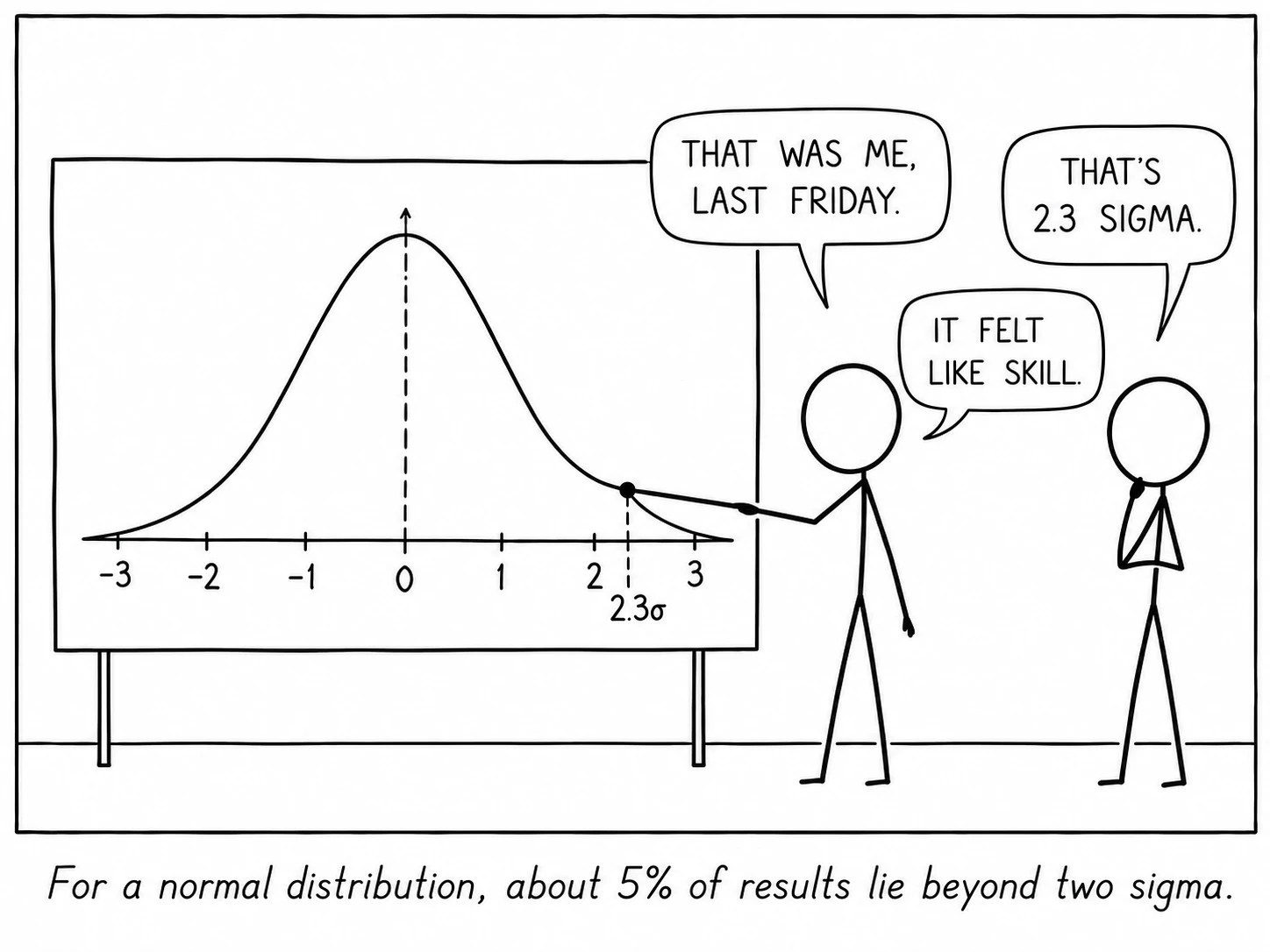
Under a normal approximation, about 5% of results lie more than two standard deviations from the mean.
Bron
- Feller, W. An Introduction to Probability Theory and Its Applications, Vol. 1.
- Ethier, S. N. The Doctrine of Chances: Probabilistic Aspects of Gambling.
- Taylor, D. G. Games, Gambling, and Probability: An Introduction to Mathematics, 2nd ed.