Falsi denki: wan roulette-strategie di e wini ala ten
“Mi abi wan sisteem di e wini 80% fu a ten.” Kande yu abi. A e lasi moni toku.

Wan sisteem kan meki sesi nanga wini kon furu. A no kan meki a fruwakti warti positief, bika ibri wedi di a e poti na −1/37 fu en wedi-moni en fruwakti warti e kon makandra. Den sisteem di e wini moro furu tron e lasi moro furu te den lasi.
San sma e taki
A bribi: wanpe wan roulette strategie de di e wini ala tron, wan sisteem fu kenki wedi-moni fu den bakapisi di pasa, di e meki roulette tron wan prei di yu e wini. A bewijs di den e gi: wan rei fu sesi nanga wini, wan video fa fu wini na roulette ibri leisi, wan sma di e fruteri, wan tabel fu wan wiki nanga bun kans. Furu tron sma e taki en nanga wan opo ati; a sma e bribi en bika a e wroko te now.
Fu san ede a no tru, ini wan lin
For an independent uniform single-zerowielNulA wan-enkri grun olo di nowan wedi fu wan tapu wan, dosen noso kolom e kibri; a sani di e meki a fordeil fu a kasino. Sma e kari en tu: wan nul, 0.Leisi ala → model with standard full-loss-on-zero payoutsmoniPaimanSan wan wedi di wini e gi yu, skrifi leki “X kontra 1”, moro leki a wedi-moni di e kon baka.Leisi ala →, each unitmoniEenheidA bigin-wedi-moni di wan sisteem noso wan preiman e wroko nanga en. Den e skrifi progressie ini eenheid so taki den e teri na iniwan tafra.Leisi ala → staked has expected net return −1/37. In a bounded session, with bets chosen using information available before each spin, expected lossmatematikiFruwakti lasiA fruwakti warti leki a totaal moni di yu wedi; a gemiddelde moni di yu e lasi ini wan sesi noso ini wan pisi ten.Leisi ala → is 1/37 of expected turnovermoniTotaal wediAla a moni di yu wedi ini wan sesi noso wan ten, nanga den wini di yu wedi baka. Sma e kari en tu: handle, action.Leisi ala →.
This statement needs its assumptions. Different payouts require a different edge, and an unbounded theoretical stopping rule cannot be handled by silently ignoring convergence conditions. A finite bankrollmoniKapitali fu preiAla a moni di yu poti na wan sei fu prei. Fa fu tiri yu kapitali fu prei wani taki: yu e bosroiti omeni fu en yu e poti na riskio ibri wedi nanga ibri sesi.Leisi ala →, table limitstafraGrens fu a tafraA moro pikin nanga a moro bigi wedi di den e gi pasi. A moro bigi grens na san e tapu progressie di e dobru.Leisi ala → and a defined stopping rule make a real system concrete enough to evaluate.
Fu san ede a e gersi leki a e wroko
Some progressionsstrategieProgressieIniwan regel di e kenki a wedi-moni fu den bakapisi di pasa. Negatief progressie e hei en baka lasi, positief progressie baka wini.Leisi ala → produce frequent small wins and occasional larger losses. The exact frequency depends on the bankroll, maximum stake, session length and reset rules. There is no universal 80% MartingalestrategieMartingaleProgressie di e meki a wedi dobru baka ibri lasi. Luku a pisi fu Strategie fu san a e du nanga san a no e du.Leisi ala → session-win rate.
For an illustrative comparison, suppose a session wins $40 with probabilitymatematikiKansA kans fu wan bakapisi, fu 0 te 1 noso fu 0% te 100%. Wan nomru: 1/37 = 2,70%.Leisi ala → 80% and loses $500 with probability 20%. Its expected result is 0.8 × $40 − 0.2 × $500 = −$68. These assumed outcomes are not simulated results for a particular Martingale configuration.
A testi di ibriwan kan du
The Strategy Simulator can help explore a specified configuration. Read its bankroll, bet rules, session length and stopping conditions before interpreting the output. A finite simulation can have a positive sample mean even when the theoretical expected return is negative. Repeatability and uncertainty matter; neither one winning session nor a simulation alone proves a universal claim.
Wan sisteem di no kan lasi
Not placing a wager avoids gambling losses. That is different from finding a betting method with a guaranteed profit. A rule advertised as risk-free may conceal this distinction, an uncovered outcome, a funding requirement or a limit it cannot satisfy.

Sisteem nanga wan nen, wan lin ibriwan
Sisteem di den e seri nanga wan nen, noso leki wan formule fu wini na roulette, no tra. Ibriwan na wan grupu wedi, en ibri wedi e pai a wiel en 2,70%. Bollman (2024) e teri wan tu fu den gi wan Amerika wiel, pe ibriwan e kostu 5,26%; dyaso den de tapu wan Europa wiel.
A leti vershi
Stake rules change the distribution of session results and the amount wagered. Under the stated model they do not create an advantage. A progression costs more in expectation than another plan only when it produces more expected turnover at the same house edgematematikiFordeil fu a kasinoA pisi fu ibri wedi-moni di a kasino e hori gemiddeld: 2,70% ini Europa-roulette.Leisi ala →; larger total stakes should not be assumed without comparing the plans.
Aksi
Siksi mun fu wan sesi ibri wiki na sowan 25 sesi. Martingale e wini 80% fu den. Den sesi nanga lasi e kon, en den moro bigi.
No. A stopping rule changes exposure and the distribution of results. It does not create positive expectation under the stated bounded-session model.
It could change the probability model if supported by evidence. That is different from merely changing stakes after independent results.
Prei nanga matematiki
Pruberi den srefi fosi. Ibri piki kibri; opo en te yu klari.
A prisiri-sisteem fu Mike Caro fu 1997 gi a Amerika-wiel e tapu rediwediRediWedi fu wan tapu wan tapu den 18 redi nomru. Na Fransi: rouge.Leisi ala → nanga blakawediBlakaWedi fu wan tapu wan tapu den 18 blaka nomru. Na Fransi: noir.Leisi ala →, oneven nanga even, nanga den nulwielNulA wan-enkri grun olo di nowan wedi fu wan tapu wan, dosen noso kolom e kibri; a sani di e meki a fordeil fu a kasino. Sma e kari en tu: wan nul, 0.Leisi ala →; oneven redi nomru nanga even blaka wan; a nomru 30; en ibri olosani fu preiOloWan fu den 37 pikin olo nanga nomru tapu a rotor. Sma e kari en tu: slot, kopu.Leisi ala → ini a pisi fu 11 lontu na a sei fa a oloisi e waka te go miti 14. Gebroiki den regel wan fu wan. Sortu nomru e tan fu wedi tapu?
Sori a piki
Piki None. It places no bets and has no gambling gain or loss; a house-edge percentage is undefined with zero turnovermoniTotaal wediAla a moni di yu wedi ini wan sesi noso wan ten, nanga den wini di yu wedi baka. Sma e kari en tu: handle, action.Leisi ala →.
Efu yu tapu redi, blaka, oneven, even nanga den nul, dan soso aparti nomru nanga pikin grupu ini 1 te go miti 36 e tan.
No oneven redi en no even blaka e libi den even redi (12, 14, 16, 18, 30, 32, 34, 36) nanga den oneven blaka (11, 13, 15, 17, 29, 31, 33, 35): siksitin nomru. Efu yu tapu 30, feifitin e tan.
Tapu a Amerika-wiel a pisi fu 11 na a sei fa a oloisi e waka te go miti 14 e kibri 32 fu den 38 olo. Den siksi na dorosei na 0, 28, 9, 26, 30 nanga 2. Ala feifitin di tan de ini a pisi, so a laste regel e puru den tu. Wan sisteem di no e wedi noiti na a wan-enkri di no e lasi noiti, en dati ben de san Caro wani sori.
Consider three capped MartingalestrategieMartingaleProgressie di e meki a wedi dobru baka ibri lasi. Luku a pisi fu Strategie fu san a e du nanga san a no e du.Leisi ala → streams on standard single-zero even-money betswediWedi fu wan tapu wanRedi/blaka, oneven/even, hei/lagi. 18 nomru, a e pai 1:1.Leisi ala →. Each uses stakes 1, 2, 4, 8, 16 and 32, then stops after six losses. For one fresh stream with sufficient funds, find its failure probabilitymatematikiKansA kans fu wan bakapisi, fu 0 te 1 noso fu 0% te 100%. Wan nomru: 1/37 = 2,70%.Leisi ala →, expected cycle result and expected turnover.
Sori a piki
Piki A e lasi ala siksi sowan wan leisi ini 55 lontu, 1,83% fu a ten, en dati e kostu 63 eenheidmoniEenheidA bigin-wedi-moni di wan sisteem noso wan preiman e wroko nanga en. Den e skrifi progressie ini eenheid so taki den e teri na iniwan tafra.Leisi ala →. Gemiddeld wan lontu e lasi sowan 0,17 eenheid fu 6,42 eenheid di yu wedi: 2,70%, a prèis fu ibri wedi tapu a wiel.
A bet loses with chance 19/37, the zero included. Six in a row: (19/37)⁶ = 0.0183, about 1 in 55, and then the stakes 1 + 2 + 4 + 8 + 16 + 32 = 63 are gone. Otherwise the cycle ends with a win and +1 unit.
Average: 1 × (1 − 0.0183) − 63 × 0.0183 = 1 − 64 × 0.0183 = −0.17 units.
Money staked: the first bet is always placed, the second only after a loss, and so on: 1 + 2 × (19/37) + 4 × (19/37)² + … + 32 × (19/37)⁵ = 6.42 units. And −0.17/6.42 = −2.70%.
For three such cycles, expected turnovers and losses add, even if the streams share spins and are correlated. Under identical cycle rules and sufficient funds, the totals are three times one stream’s expectations. A shared bankrollmoniKapitali fu preiAla a moni di yu poti na wan sei fu prei. Fa fu tiri yu kapitali fu prei wani taki: yu e bosroiti omeni fu en yu e poti na riskio ibri wedi nanga ibri sesi.Leisi ala → or a shared stop rule can change which bets are actually placed.
Wan pikin lafu
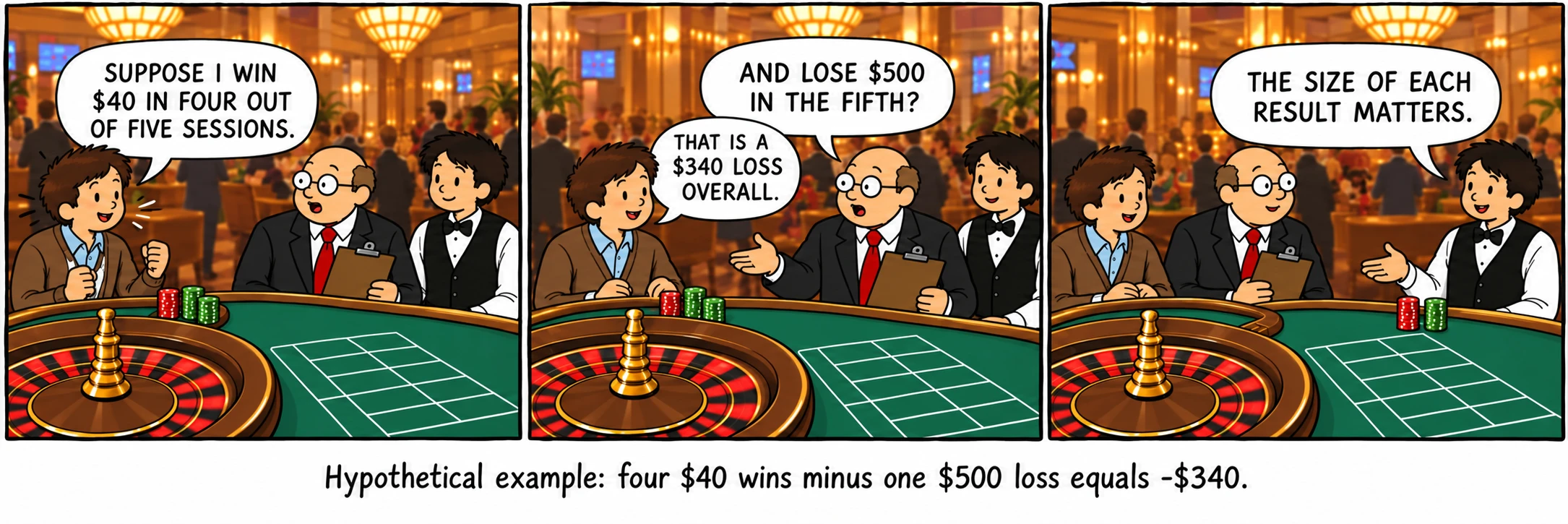
Hypothetical example: four $40 wins minus one $500 loss equals −$340.
Bron
- Thorp, E. O. “Optimal gambling systems for favorable games.”
- Thorp, E. O. The Mathematics of Gambling.
- Doob, J. L. “Note on probability.”
- Halmos, P. R. “Invariants of certain stochastic transformations: the mathematical theory of gambling systems.”
- Ethier, S. N. The Doctrine of Chances: Probabilistic Aspects of Gambling.
- Bollman, M. Mathematics of the Big Four Casino Table Games: Blackjack, Baccarat, Craps, & Roulette.
- Bollman, M. Basic Gambling Mathematics: The Numbers Behind the Neon, 2e druk.